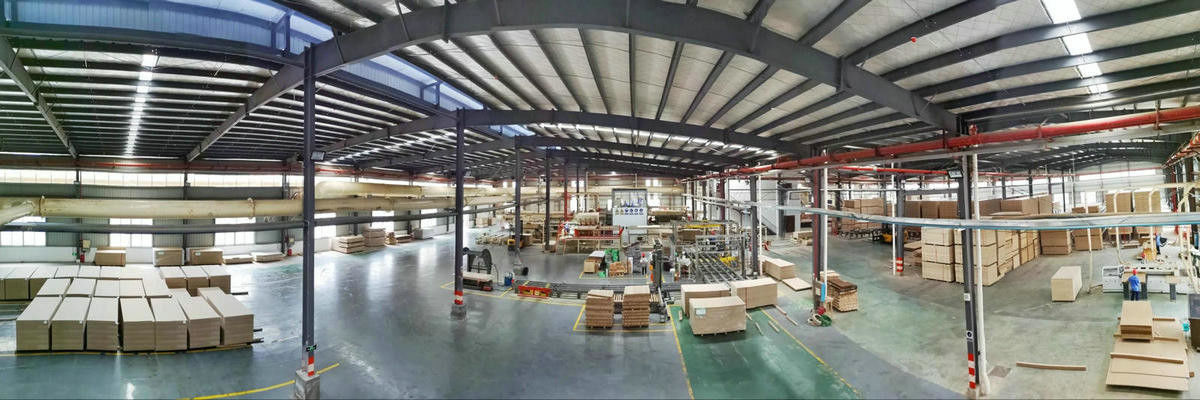
The Role of OSB Production Lines in Modern Construction Material Manufacturing
Oriented Strand Board (OSB) is one of the fastest-growing engineered wood products in the world, widely used in residential, commercial, and industrial construction. As demand continues rising in North America and Europe, the need for highly efficient OSB Production Lines becomes increasingly important. A complete OSB Production Line is a sophisticated integration of raw material preparation, precision machining, chemical processing, thermal pressing, and finishing technologies designed to transform wood strands into high-strength structural panels. The entire process is engineered to ensure consistent mechanical strength, moisture resistance, and dimensional stability, making OSB a reliable alternative to plywood and other traditional wood materials.
The process begins with log preparation, where debarking machines remove bark, dirt, and foreign materials to protect downstream machinery. Clean logs are essential for achieving uniform strand quality. After debarking, logs are fed into high-capacity flaking systems. These machines cut logs into long, thin strands with controlled length and thickness. Strand quality heavily influences panel strength, stiffness, and load-bearing capacity, making precision flaking one of the most critical steps in OSB manufacturing.
Strands then enter drying systems, which reduce moisture content to optimal levels for resin blending and hot pressing. Modern dryers use energy-efficient heating systems with real-time temperature monitoring to ensure even drying across all fibers. Uniform moisture levels are vital for consistent resin curing and panel strength. Following drying, strands are screened and classified to remove fines, dust, and oversized particles. Proper classification improves mat forming accuracy and ensures stable density profiles in finished panels.
After screening, strands proceed to resin blending, where advanced dosing systems apply precise amounts of adhesive and wax to each strand. Uniform resin application is essential for mechanical bonding strength, water resistance, and durability. Automated blending reduces glue waste and improves production efficiency. Most OSB manufacturers use PMDI resin for structural-grade panels due to its strong bonding capability and excellent moisture performance.
The next stage is mat forming, where strands are distributed into multiple layers with specific orientation patterns. Surface layers are oriented parallel to the panel length for bending strength, while core layers are cross-oriented for stability. High-accuracy forming systems equipped with sensors and feedback controls ensure uniform distribution, preventing density fluctuations and improving structural consistency.
The formed mat enters the hot pressing section, the technological core of the OSB Production Line. Continuous hot presses compress the mat under controlled temperature and pressure, activating the resin and forming a dense, rigid board. Precise control of pressure curves, temperature zones, and pressing speed allows manufacturers to produce panels with uniform density profiles and minimal defects. Modern presses also integrate automated lubrication, thickness control, and real-time monitoring systems.
After pressing, panels undergo cooling, sawing, sanding, and grading. Cooling stabilizes the internal structure, preventing warping or deformation. Automated saw lines trim edges to exact dimensions, while sanding systems ensure a uniform surface suitable for construction, laminating, or manufacturing. Quality control systems equipped with optical and laser scanning technologies evaluate each panel’s thickness, density, and structural integrity before stacking and packaging.
OSB Production Lines offer numerous advantages for manufacturers, including high automation levels, reduced labor requirements, stable operation, and increased output capacity. Energy-efficient machinery and optimized material usage reduce production costs while improving sustainability. With growing demand for environmentally friendly building materials, OSB panels manufactured using modern production lines meet stringent U.S. and European standards for structural performance, fire resistance, and moisture protection.
Investing in an advanced OSB Production Line enables manufacturers to expand production capacity, improve product quality, and enhance competitiveness in global markets. With precise engineering, intelligent automation, and robust process control, these production lines are essential for meeting the growing demand for high-performance engineered wood products in modern construction.


 Your message must be between 20-3,000 characters!